

Can you tell us a little bit about your background and research focus?
I started my research journey at the UCL Institute of Child Health back in 2013. I did my PhD there on how to optimise the quality of brain imaging data that was being used to help plan neurosurgery for young people with epilepsy. I then moved to the Department of Imaging Neuroscience (still in UCL) in 2017 where I started developing a new brain imaging technology.
That technology was called the Optically Pumped Magnetometer and measures the magnetic fields generated by the brain’s activity. By 2021 I was certain this technology could be used to help better plan brain surgery and provide earlier diagnosis for young people with epilepsy.
You were awarded the Epilepsy Research Institute & Young Epilepsy Fellowship in 2021. Can you tell us a little bit about your project — what it set out to explore and the impact you hope it will have?
There were a couple of problems I wanted to solve. Firstly, there was no clinical data from young people using this technology to show it worked and secondly the technology was very expensive as it had to be kept in a bank vault-like structure called a magnetically shielded room. The fellowship project could both get us that data we needed to assess clinical efficacy and also start thinking about how we overcome the engineering challenge of requiring a magnetically shielded room.
What has been the most interesting or significant finding to come out of your project so far?
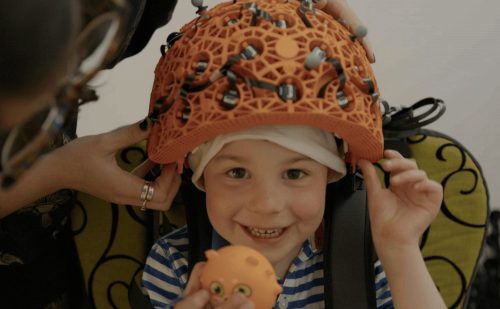
I knew from the outset that I wanted to involve young people with epilepsy in the project beyond them just being participants. I’m quite proud of the fact we co-created helmets, fun activities to take place during the brain scanning visits, and even the very room design. Check out the film and report if you want to learn more.
Building on what we learned from our co-creation project we performed the very first brain scans of young people with epilepsy using this technology in the UK. This was a huge milestone for the project and the brilliant team at Young Epilepsy are now taking this work forward to do a much larger scale clinical validation of the technology. Watch this space!
We’ve also made substantial progress on developing a prototype brain imaging system that works without the need for a magnetically shielded room, reducing cost and space requirements massively. The focus of the final year of my fellowship is getting this prototype fully operational and demonstrating its utility. We hope this will have a great impact in hospitals and ultimately help propagate this technology worldwide so as many people as possible can benefit.
How has the support from the Epilepsy Research Institute and Young Epilepsy helped shape your research journey?
The support provided via this fellowship has been incredibly important for me personally. The fellowship was my first successful funding application, which is a big milestone in an academic career. It then gave me the confidence to apply for further funding, and I was promoted to a managerial position in my department. Recently, as of 14 April 2025, I was appointed to a permanent lectureship position in my department.
Congratulations on your recent lectureship offer! Could you tell us more about this new role and what it means for the next stage of your career?
Practically, my research won’t be changing, but I am going to have new responsibilities in organising and delivering a new undergraduate course in neuroscience at UCL. I’m incredibly excited about all of this but I couldn’t have done it without the support of so many people. In particular, my colleagues at UCL, Great Ormond Street, Queen Square, and of course, Young Epilepsy who have all tirelessly assisted with patient recruitment and troubleshooting throughout.
Finally, I would like to thank the young people who have participated in the study, their parents for giving up their time, and, of course, all the supporters of Young Epilepsy and Epilepsy Research Institute who have made this a reality. Thanks everyone!