

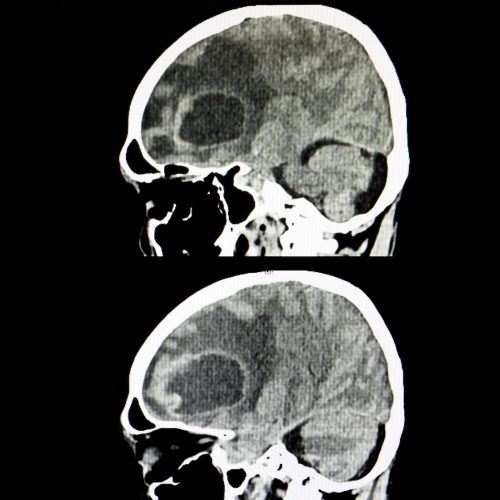
“After my son was born, I started experiencing headaches which progressively became worse,” Dominique recalls. “My GP initially thought that it was due to stress, when in reality I had a tumour the size of an orange growing in my brain.”
Dominique quickly had her brain tumour removed, but as she was recovering from brain surgery, she started experiencing seizures.
It took a long time to find the right treatment to control her epilepsy. “Just when we thought we had found a medication and dosage that worked, I’d have more seizures and we would have to increase my dosage again,” says Dominique.
There are many reasons an individual may have a seizure, but we know that two in three people diagnosed with a brain tumour will experience at least one. For this group of people, a seizure might be the first sign of the tumour, while for others like Dominique, seizures can start after their treatment. Individuals can experience different kinds of seizures depending on the site of the tumour in their brain. However, it is important to emphasise that seizures do not necessarily indicate an underlying tumour, and professional medical advice should always be sought.
But there is a lot about the link between epilepsy and brain tumours that we don’t understand. Why do certain types, like slow growing low-grade tumours, more often lead to epilepsy than other types? And what exactly is a tumour doing to the brain that leads to seizures?
Research can find the answers to these questions. The work of the Epilepsy Research Institute, Brain Tumour Research, and others, is helping us make sure that one day people don’t have to face epilepsy as well as a brain tumour.
A key focus of research in this area is to understand exactly how tumours cause seizures in the brain.
Take tuberous sclerosis complex (TSC), for example – a genetic condition where non-cancerous tumours develop across the body, including the brain. Drug-resistant epilepsy is very common in TSC, affecting about 8 in 10 people living with the condition, but it is not clear why.
Dr Amanda Almacellas Barbanoj is investigating how TSC affects the development of the brain and causes seizures. In her research, jointly funded by the Epilepsy Research Institute and the Tuberous Sclerosis Association, she hopes to identify new targets for future treatments that can improve the lives of children affected.
New treatments for brain tumour-related epilepsy could stop the trial-and-error rollercoaster which Dominique and others have experienced. For example, people living with glioblastomas often experience difficult-to-treat seizures. With support from the Institute, Dr Kate Hills is developing a gene therapy focusing on support cells in the brain called astrocytes. Her research could eventually lead to a new, personalised therapy to better control seizures in glioblastoma.
Alongside funding six Brain Tumour Research Centres of Excellence which focus on understanding and developing new, more effective treatments for all types of brain tumour, Brain Tumour Research also invests in the infrastructure that helps drive discovery.
Through BRAIN UK, the world’s first national virtual brain tissue bank, researchers can access vital tumour samples to study brain tumours and associated conditions, including epilepsy. This helps ensure scientists have the resources they need to carry out high-quality research in the UK.
Brain Tumour Research also partner with the charity brainstrust to fund its Patient Research Involvement Movement (PRIME) to improve patient and public involvement in brain tumour clinical research. PRIME ensures that patient and caregiver insights shape the design of studies, helping make new treatments more responsive, supportive and aligned with real needs.
Like many areas of epilepsy, research into brain tumour-related seizures has been under-funded for a long time. We need to make sure new funding is invested in the right areas. We need research that helps us to:
To transform promising scientific discoveries into meaningful change for people with brain tumour-related seizures we need to:
I am so grateful for the positive impact research has had
After years of struggling to find the right treatment to control her seizures, Dominique opted for Vagus Nerve Stimulation (VNS) therapy, which has significantly improved her life. “Even though I am still having seizures while being on the VNS, they are nowhere near as bad as before.”
This, Dominique says, was only made possible thanks to research. “I am so grateful for the positive impact research has had, not just for me, but for my family too.”
The feature was made in collaboration with Brain Tumour Research. Find out more about their work here.